
Unraveling the Mystery of “この” in Japanese Grammar: A Humorous Exploration


Unraveling the Mystery of “この” in Japanese Grammar: A Humorous Exploration
Estimated reading time: 2 minutes
Introduction:
Greetings, language enthusiasts! Today, we embark on a journey through the labyrinth of Japanese grammar, focusing our attention on the enigmatic particle “この” (kono). Buckle up and get ready for an exhilarating ride filled with laughter, learning, and linguistic adventures!
Exploring “この” (kono):
In Japanese, “この” (kono) is a demonstrative pronoun used to indicate “this” when followed by a noun. Let’s delve into its usage with some hilarious examples:
- Example 1:
- Japanese: この猫 (kono neko)
- English: This cat
- Pronunciation: कोनो नेको (kono neko)
- Romaji: Kono neko
- Example 2:
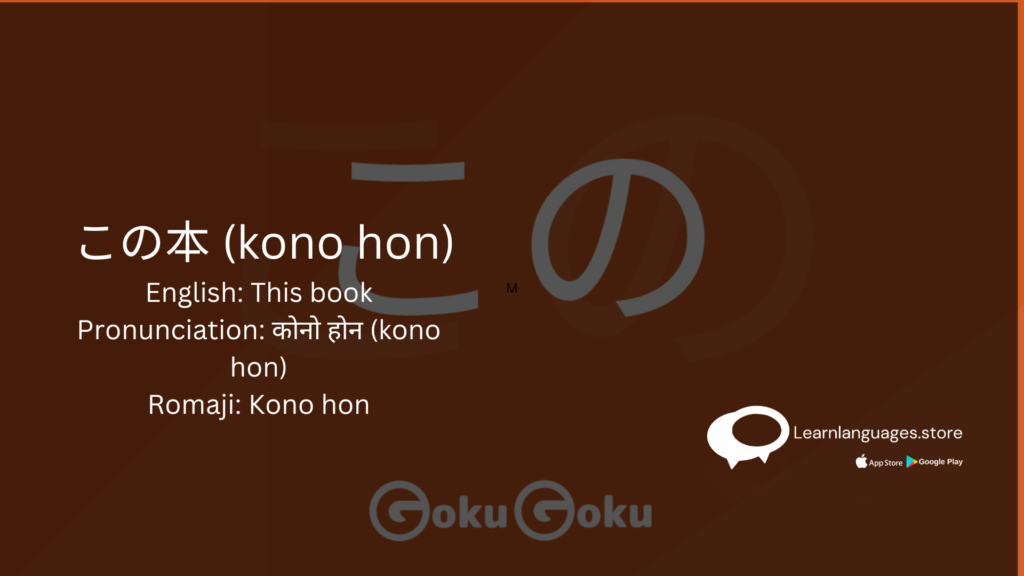
- Japanese: この本 (kono hon)English: This bookPronunciation: कोनो होन (kono hon)Romaji: Kono hon
Exceptional Cases:
While “この” (kono) typically precedes nouns, there are exceptions where it can stand alone to refer to something understood within the context.
Conclusion:
In conclusion, “この” (kono) serves as a vital tool in Japanese grammar, allowing speakers to indicate proximity and specify objects with ease. With its versatile usage, mastering “この” (kono) opens doors to clearer communication and deeper understanding in the Japanese language.
So there you have it, folks! Armed with humor and insight, we’ve navigated the complexities of “この” (kono) in Japanese grammar. Until next time, keep exploring, keep laughing, and keep learning!
-
Product on sale
 Japanese N3
₹42,600.00
₹52,600.00 -
Product on sale
 Japanese N4
₹28,300.00
₹42,600.00 -
Product on sale
 Japanese N5
₹18,300.00
₹24,300.00
Learn Languages Store
Vashi,
Email: services@learnlanguages.store