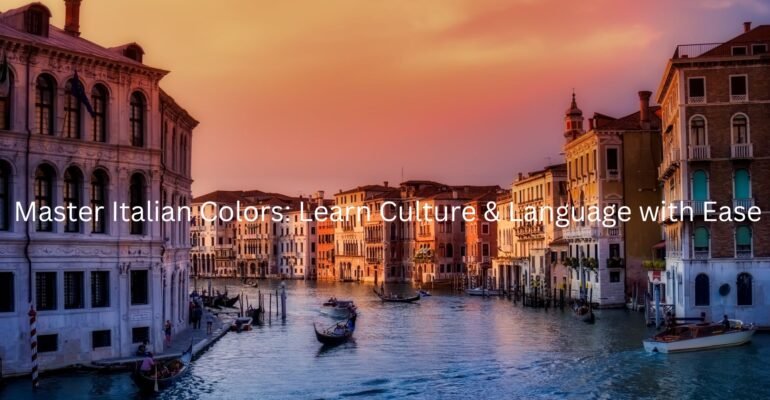
Master the Beauty of Italy by Learning 83 Colors in Italian

Estimated reading time: 4 minutes
Table of contents
- Why Learning Colors in Italian is Vital
- 1. Basic Italian Colors You’ll Use All the Time
- 2. Italian Colors Derived from Nature and Materials
- 3. Shades, Tones, and Descriptions
- 4. Grammar Rules for Colors in Italian
- 5. Cultural Importance of Colors in Italy
- 6. Describing People Using Colors in Italian
- 7. Common Italian Expressions with Colors
- 8. Tips for Learning Colors in Italian
- 9. Why Learn Italian with Learn Languages Store
Colors are the heart of vivid expression, and in a country like Italy, with its vibrant landscapes, historical richness, and artistic heritage, colors play a central role in communication and storytelling. If you’re starting your journey to learn Italian, mastering i colori (the colors) is an essential and exciting step.
Why Learning Colors in Italian is Vital
Colors are more than mere adjectives—they bring life to descriptions, making conversations vibrant and memorable. Whether you’re marveling at a Tuscan sunset, ordering gelato, or describing a masterpiece in a museum, knowing the names and nuances of Italian colors enriches your cultural and linguistic experience.
1. Basic Italian Colors You’ll Use All the Time
Start your journey with these fundamental colors. They’re part of everyday conversation and essential for navigating through Italy’s colorful streets.
| Color | Italian | Pronunciation | Example Sentence |
|---|---|---|---|
| Red | Rosso | ROH-soh | Il pomodoro è rosso. (The tomato is red.) |
| Blue | Blu | BLOO | Il mare è blu. (The sea is blue.) |
| White | Bianco | BYAHN-koh | La neve è bianca. (The snow is white.) |
| Green | Verde | VEHR-deh | L’erba è verde. (The grass is green.) |
| Yellow | Giallo | JAH-loh | Il sole è giallo. (The sun is yellow.) |
| Black | Nero | NEH-roh | Il gatto è nero. (The cat is black.) |
2. Italian Colors Derived from Nature and Materials
Many Italian colors are inspired by natural elements, materials, and traditions. Learning these words will make your vocabulary richer and help you connect with Italy’s artistic and cultural heritage.
| Color | Italian | Pronunciation | English Translation |
|---|---|---|---|
| Aquamarine | Acquamarina | AH-kwah-mah-REE-nah | Aquamarine |
| Amber | Ambra | AHM-brah | Amber |
| Coral | Corallo | KOH-rahl-loh | Coral |
| Ruby | Rubino | ROO-bee-noh | Ruby |
3. Shades, Tones, and Descriptions
Add depth to your vocabulary by learning how to describe shades and finishes. Italians love specifics, and these words will make you sound like a local.
- Chiaro (KEE-ah-roh) = Light
Ho comprato una giacca rosa chiaro. (I bought a light pink jacket.) - Scuro (SKOO-roh) = Dark
La mia macchina è blu scuro. (My car is dark blue.) - Luminoso (LOO-mee-NOH-soh) = Bright
Il cielo è luminoso oggi. (The sky is bright today.)
4. Grammar Rules for Colors in Italian
Colors in Italian must agree with the gender and number of the noun they describe.
Gender Agreement
- Un vestito rosso (A red dress – masculine singular)
- Una camicia bianca (A white shirt – feminine singular)
Number Agreement
- I vestiti rossi (The red dresses – masculine plural)
- Le scarpe bianche (The white shoes – feminine plural)
5. Cultural Importance of Colors in Italy
Colors hold special meaning in Italian culture. For inst
6. Describing People Using Colors in Italian
Use colors to describe physical features like eyes, hair, and skin tones.
Eye Colors
- Ho gli occhi azzurri. (I have light blue eyes.
7. Common Italian Expressions with Colors
Colors also appear in idiomatic expressions. Here are a few:
- Vedere rosso = To see red (to be very angry)
- Essere al verde = To be broke (literally, “to be in green”)
8. Tips for Learning Colors in Italian
- Use flashcards with visuals of objects and their colors.
- Practice role-playing, such as shopping for clothes and describing your preferences.
- Watch Italian movies and pay attention to color-related descriptions.
9. Why Learn Italian with Learn Languages Store
At Learn Languages Store, we offer a unique learning experience tailored for language enthusiasts.
Understanding Italian colors requires associating words with real-life objects. Practice by labeling household items, creating flashcards, or using apps like Rosetta Stone that integrate visuals and pronunciation.
Colors in Italian are adjectives and must match the gender (masculine/feminine) and number (singular/plural) of the noun they describe. For example:
Masculine singular: “un vestito rosso” (a red dress)
Feminine plural: “le scarpe rosse” (the red shoes)
Yes! Colors are deeply tied to Italy’s history, art, festivals, and identity. Learning color-related expressions like “rosso di vergogna” (red with shame) or understanding the symbolism of “azzurri” (the national team color) enriches both language skills and cultural insights.
Why Choose Us?
- Location: 330, 3rd Floor, Big Splash, Sector 17, Vashi, Navi Mumbai.
- Expert Trainers: Professional instructors with experience in teaching Italian.
- Interactive Courses: Dynamic Immersion techniques to help you learn naturally.
- Contact Us: Call us at +91-9594113111 or email services@learnlanguages.store.
Ready to Start Your Italian Journey?
With the support of Learn Languages Store, mastering Italian colors and much more will be effortless and enjoyable. Dive into the beauty of Italy, one color at a time!