
Exploring the Enigmatic “Sono その” in Japanese Grammar: A Comprehensive Guide

Exploring the Enigmatic “Sono その” in Japanese Grammar: A Comprehensive Guide
Estimated reading time: 3 minutes
Introduction:
Greetings, fellow language enthusiasts! Today, we embark on a fascinating journey through the intricate world of Japanese grammar to unravel the mysteries of “sono” (その), a versatile demonstrative pronoun. Whether you’re a beginner or an advanced learner, understanding “sono” is crucial for mastering Japanese conversation and comprehension. So, let’s dive in and explore its nuances together!
What is “Sono” and Its Basic Usage?
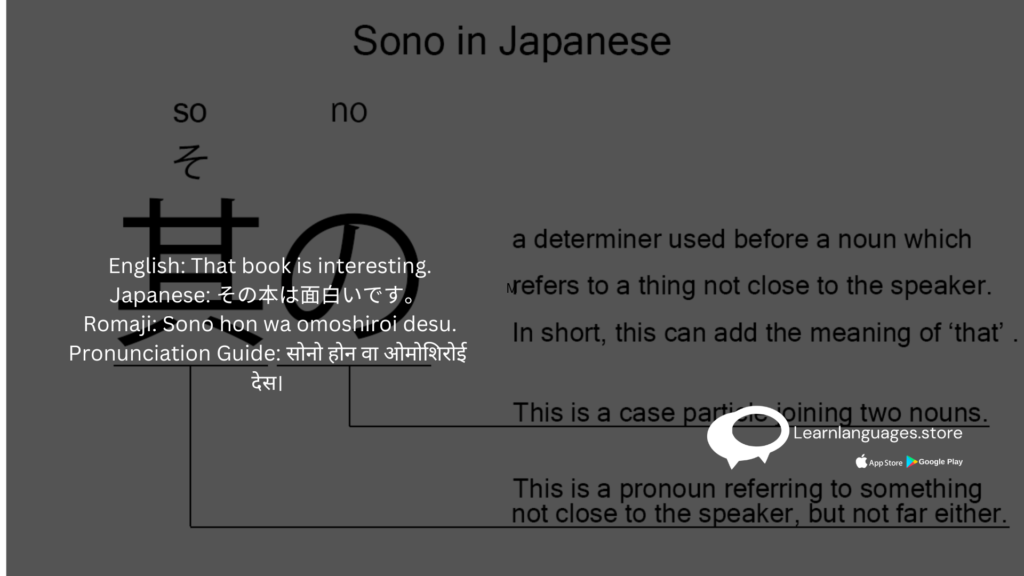
“Sono” is a demonstrative pronoun in Japanese, meaning “that” or “those” when followed by a noun. It is used to indicate objects, people, or ideas that are close to the listener but farther from the speaker.
Example 1:
English: That book is interesting.
Japanese: その本は面白いです。
Romaji: Sono hon wa omoshiroi desu.
Pronunciation Guide: सोनो होन वा ओमोशिरोई देस।
In this example, “sono” is used to refer to the book (hon) that is close to the listener but not the speaker.
Exception:
One important exception is when the noun “sono” modifies is a distant object or concept, in which case it can translate to “the” or “those” in English, rather than “that” or “those.”
Additional Usages and Expressions with “Sono”
“Sono” can also be used in various expressions and idiomatic phrases in Japanese.
Example 2:
English: That’s right!
Japanese: そうですね、その通りです!
Romaji: Sō desu ne, sono tōri desu!
Pronunciation Guide: सोऊ देस ने, सोनो तोरी देस।
In this expression, “sono” emphasizes agreement or confirmation with the speaker’s statement.
Conclusion
In conclusion, “sono” is a versatile and essential component of Japanese grammar, used to indicate objects or ideas close to the listener. By mastering its usage and exceptions, learners can enhance their language skills and engage in more fluent and natural conversations. So, keep practicing and exploring the fascinating world of Japanese grammar!
-
Product on sale
 Japanese N3
₹42,600.00
₹62,600.00 -
Product on sale
 Japanese N4
₹24,300.00
₹32,600.00 -
Product on sale
 Japanese N5
₹18,300.00
₹24,300.00
Learn Languages Store
Vashi,
Email: services@learnlanguages.store