
Mastering Japanese Grammar: Understanding “これ” (Kore): This (near speaker)


Mastering Japanese Grammar: Understanding “これ” (Kore): This (near speaker)
Estimated reading time: 3 minutes
Introduction to “これ” (Kore)
Greetings from the fascinating world of Japanese grammar! Today, we embark on an exciting journey to delve into the usage of “これ” (kore), a demonstrative pronoun that is essential in Japanese conversations. Let’s make this informative and fun with plenty of examples, humor, and in-depth explanations.
“これ” (kore) translates to “this” in English and is used to refer to something that is near the speaker. It’s an essential part of everyday Japanese language and helps in pointing out objects or topics in conversation.
The Structure of “これ” (Kore)
In Japanese, “これ” is used as a pronoun and can stand alone or be followed by a noun. Let’s break down its usage with some examples.
Basic Sentence Structure
- これです (Kore desu) – This is it.
- これ (Kore) – This
- です (desu) – is (polite form)
- これは本です (Kore wa hon desu) – This is a book.
- これ (Kore) – This
- は (wa) – topic marker
- 本 (hon) – book
- です (desu) – is
Examples with English and Hindi Translation
- これです (Kore desu) – This is it.
- Pronunciation: कोरे देसु
- Romaji: Kore desu
- Hindi: यह है
- これはペンです (Kore wa pen desu) – This is a pen.
- Pronunciation: कोरे वा पेन देसु
- Romaji: Kore wa pen desu
- Hindi: यह एक पेन है
- これはおいしいです (Kore wa oishii desu) – This is delicious.
- Pronunciation: कोरे वा ओइशी देसु
- Romaji: Kore wa oishii desu
- Hindi: यह स्वादिष्ट है
- これはあなたのですか? (Kore wa anata no desu ka?) – Is this yours?
- Pronunciation: कोरे वा अनाता नो देसु का?
- Romaji: Kore wa anata no desu ka?
- Hindi: क्या यह आपका है?
Usage and Exceptions
“これ” is straightforward to use but here are some points to remember:
- It always refers to something close to the speaker.
- It can be used alone or before a noun.
- In casual speech, です (desu) can be dropped, e.g., これはペン (Kore wa pen) – This is a pen.
Humorous Examples
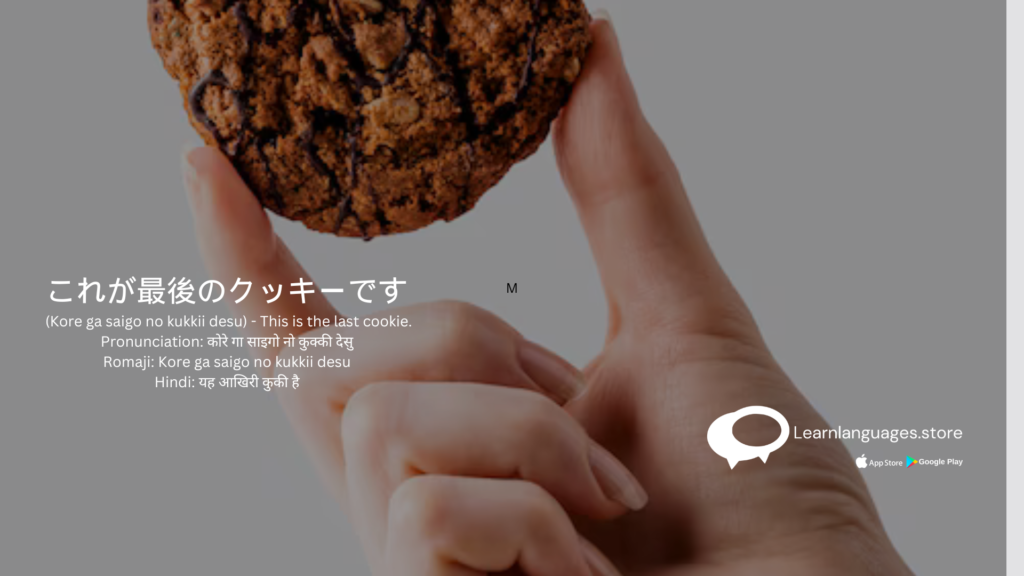
- これが最後のクッキーです (Kore ga saigo no kukkii desu) – This is the last cookie.
- Pronunciation: कोरे गा साइगो नो कुक्की देसु
- Romaji: Kore ga saigo no kukkii desu
- Hindi: यह आखिरी कुकी है
- これは秘密です (Kore wa himitsu desu) – This is a secret.
- Pronunciation: कोरे वा हिमित्सु देसु
- Romaji: Kore wa himitsu desu
- Hindi: यह एक रहस्य है
Conclusion
Identifying in a sentence: “これ” is an indispensable demonstrative pronoun that helps point out things near the speaker, making it easier to communicate effectively in Japanese.
Using “これ” simplifies conversations, making them more precise and engaging. Next time you’re in Japan, confidently use “これ” to talk about items near you and impress your friends with your language skills.
-
Product on sale
 Japanese N3
₹42,600.00
₹62,600.00 -
Product on sale
 Japanese N4
₹24,300.00
₹32,600.00 -
Product on sale
 Japanese N5
₹18,300.00
₹24,300.00
Learn Languages Store
Vashi,
Email: services@learnlanguages.store