
Mastering the Use of 〜ないで (naide) in Japanese Grammar


Estimated reading time: 4 minutes
こんにちは (Konnichiwa)! Welcome back to another exciting lesson on Japanese grammar. Today, we are diving deep into the world of 〜ないで (naide). This phrase is commonly used to express “without doing” or to request someone not to do something. By the end of this blog, you’ll have a thorough understanding of 〜ないで (naide) with plenty of humorous examples to keep things light and enjoyable.
Understanding 〜ないで (naide)
Sentence Structure
The structure for using 〜ないで (naide) is straightforward. It involves attaching ないで (naide) to the plain negative form of a verb. Here’s the basic breakdown:
- Verb (negative plain form) + ないで (naide)
Examples with Contexts
- Expressing “Without Doing”:
- Example: 朝ごはんを食べないで学校に行った。 (あさごはんをたべないでがっこうにいった。)
- Pronunciation: आसा गोहान ओ ताबेनाइदे गक्को नी इत्ता। (Asa gohan o tabenaide gakkou ni itta.)
- English Translation: “I went to school without eating breakfast.”
- Hindi Translation: “मैं बिना नाश्ता किए स्कूल गया।”
- Humorous Twist: “मैं बिना नाश्ता किए स्कूल गया, और फिर भी मेरे दोस्त ने सोचा कि मैं नाश्ता चोरी करने वाला हूं!”
- Requesting Not to Do Something:
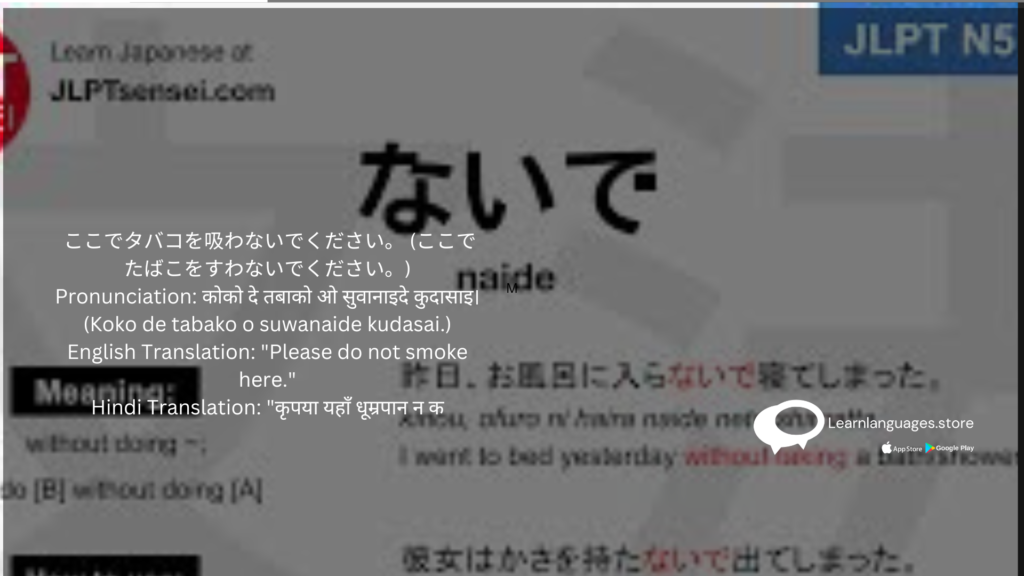
- Example: ここでタバコを吸わないでください。 (ここでたばこをすわないでください。)
- Pronunciation: कोको दे तबाको ओ सुवानाइदे कुदासाइ। (Koko de tabako o suwanaide kudasai.)
- English Translation: “Please do not smoke here.”
- Hindi Translation: “कृपया यहाँ धूम्रपान न करें।”
- Humorous Twist: “कृपया यहाँ धूम्रपान न करें, वरना हमारी बिल्ली सोचेगी कि हम आग लगा रहे हैं!”
- Prohibition:
- Example: この部屋に入らないでください。 (このへやにはいらないでください。)
- Pronunciation: कोनो हेया नि हैरानाइदे कुदासाइ। (Kono heya ni hairanaide kudasai.)
- English Translation: “Please do not enter this room.”
- Hindi Translation: “कृपया इस कमरे में प्रवेश न करें।”
- Humorous Twist: “कृपया इस कमरे में प्रवेश न करें, जब तक कि आप एक भूत के दोस्त नहीं हैं!”
- Advising Against an Action:
- Example: 夜更かししないで、早く寝なさい。 (よふかししないで、はやくねなさい。)
- Pronunciation: योफुकाशी शिनाइदे, हयाकु नेनासाइ। (Yofukashi shinaide, hayaku nenasai.)
- English Translation: “Don’t stay up late; go to bed early.”
- Hindi Translation: “देर तक जागे मत रहो; जल्दी सो जाओ।”
- Humorous Twist: “देर तक जागे मत रहो, वरना सुबह की चाय बनाने वाली मशीन भी तुम्हें माफ नहीं करेगी!”
Usage and Nuances
- Expressing “Without Doing”: One of the primary uses of 〜ないで (naide) is to indicate doing something without performing another action.
- Making Requests: It is commonly used in polite requests to ask someone not to do something.
- Prohibitions: Often seen on signs and instructions to prohibit certain actions.
- Advising: Useful for giving advice or instructions on what not to do for better outcomes.
Exceptions and Variations
- Imperative Form: For stronger prohibitions, especially in commands, 〜な (na) can be used instead of 〜ないで (naide). For example, 食べるな (taberu na) means “Don’t eat!”
- Combined with ください (kudasai): For polite requests, always use 〜ないでください (naide kudasai) to soften the command.
- Contextual Use: Sometimes, 〜ないで (naide) can be substituted with 〜ずに (zu ni), another form meaning “without doing,” though it’s less common in casual speech.
Identifying 〜ないで (naide) in a Sentence
To identify 〜ないで (naide) in a sentence, look for the negative plain form of a verb followed by ないで (naide). This indicates that the action was either not performed or is being requested not to be performed.
Conclusion
In conclusion, 〜ないで (naide) is an essential and versatile phrase in Japanese that helps express actions done without something else or to request someone not to do something. By mastering its usage, you’ll be able to communicate more effectively and naturally in Japanese. Practice using 〜ないで (naide) with our humorous examples, and soon you’ll be incorporating it effortlessly into your conversations.
-
Product on sale
 Japanese N3
₹42,600.00
₹62,600.00 -
Product on sale
 Japanese N4
₹24,300.00
₹32,600.00 -
Product on sale
 Japanese N5
₹18,300.00
₹24,300.00
Learn Languages Store
Vashi,
Email: services@learnlanguages.store